THE DESK
The Company I Kept
I went looking for companions in the liminal. I found lineage instead.




When I left, I didn’t know what I was going to do.
I’d just turned in my badge. A decade given to the machine. Hours for compensation, prestige for a paragraph in my title, the whole arrangement: badge in, badge out, always knowing exactly where I was supposed to be.
I went and sat on a bench in Marshall Park, looking out over Puget Sound. I chose it on purpose. It was the same bench I’d sat on ten years before, the week I entered the machine — back when the anxiety was so total that the only thing that helped was staring at the water until I felt small. I remember that first sit. The fog of it. Rooms I didn’t understand, pedigrees that weren’t mine, and underneath it all the good-girl scold: aren’t you lucky to be here? Shouldn’t you stop whining?
Same bench. Same horizon. Different woman. The discernment had grown teeth — the kind you only feel after living a life. Nothing was lined up. The economy outlook was grim, the AI panic was hitting fever pitch, every meeting inside the machine had started to feel like men guarding fiefdoms. And I sat in the middle of that storm and looked straight into it like a woman who’d survived her own undoing and come back stronger than she’d known she was. For no reason except that she was still breathing. Good linen. Glowing skin. Still breathing at the same bench felt like enough.
The reasonable version was right there. Portfolio, a couple of AI courses, back into interviews, land a top AI PM job. Everyone could see that bridge. Everyone would have nodded. It was the good-girl path — the one that got me here, that let me earn a living my great-grandmother Caroline would have fainted over. She slept beside the pigs for warmth in her village in Italy, then crossed an ocean as a teenager and started again in Oregon.
But it didn’t feel right. Not in my bones. I’d had that exact feeling only twice before, both times at thresholds that looked right on paper to everyone around me and felt wrong to live. So I didn’t take it. I could see the whole predictable arc of it — waterfront property, manicured hydrangeas, glasses clinking under the stars at the party of my dreams, social performance so polished it’s wallpaper — and even painted that beautifully, it would have been a self-betrayal to never try the thing I needed to try. No matter how good the backdrop.
I’d also read enough to know the upside of a move like this. The biographies all had it in common: Jobs, Obama, da Vinci, every one of them with a stretch of protected, unproductive-looking time between closing one door and opening the next. The part everyone is afraid of. The liminal. It’s where the work gets made that’s still breathing long after the person who made it isn’t.
Almost no one stays in it long enough to find out. Mostly I was wildly curious what I’d build if my time were finally, fully my own.
So I left. On purpose. I closed the door and didn’t reach for the next handle, and I held the space open even when holding it felt like doing nothing — even when every instinct I’d built over a decade at Amazon was screaming to produce something, prove something, have the résumé updated by Friday. Whole days went by with nothing to show. No résumé. No course. It felt like a detox, and some days it hurt like one.
And then one day it didn’t. The ache thinned into something quieter, and the quiet, once I stopped bracing against it, turned out not to be empty. It had only been waiting for me to stop filling it.
That was when the questions started coming. I’d be doing nothing at all, at rest under the wisteria in my garden, and one would drift up that the old plan had never left room for. What if women had held the pen on how technology worked, from the very beginning? What would we have built first? Would we have cared about growth at any cost, about metrics that flatten a human being down to a number you can optimize? Or would we have started somewhere the men holding the pen never thought to look?
I didn’t have answers yet — but for the first time, I’d given myself permission to ask the questions. And that was the whole flip. The asking was the work starting. My mind had gone somewhere it was never allowed to go, and it didn’t come back the same.
But a mind running that far past its own edges needs care, and I didn’t have a community yet to help me. So I went looking. This is the record of what I found.
The Desk — what was actually on it. Not the highlight reel. The real diet. What I reached for in the months when I didn’t know what I was becoming and had to find out from somewhere. Mostly I found it in women who’d already stood where I was standing. Most of them I’d never met. Some of them have been dead for fifty years.
Stillness
The first thing I did was build a playlist I never would have built.
That was AI’s idea. I’d handed it everything — the anxiety, the flatness, the vertigo, the way I reach for rage and high tempo whenever I’m scared or angry — and it told me to go the other direction. Make something soft. Fill it with women I never listen to. So I did, half rolling my eyes: FKA Twigs, Weyes Blood, Mazzy Star, BANKS, Rosalía.
I played it while I cooked, while I painted, letting the energy do osmosis into my psyche. And somewhere in those weeks it taught me the thing I’d actually come looking for. The thing every one of these women already knew. Power that’s sure of itself has no need to raise its voice. It sits in its own bones and waits. Weyes Blood especially: I’d put her on and feel let into a room I didn’t know was in the house.
Not all of it was high art, for the record. A truly ridiculous amount of Real Housewives of Beverly Hills got watched in those months — proof that no fortune or audience size ever bought anyone out of fear, and the easiest way to stay close to my sister, on maternity leave at the same time, trading gifs at midnight. Some company keeps you sane so you can do the harder looking. And that was real, I needed it to round out the diet, but this is about the harder looking.
Then there was Cléo.
Cléo from 5 to 7 came through the loose syllabus I’d built for the pause (also with AI). I’d asked for a film about a woman who moves from performing to being herself, and it arrived like it had been waiting. The whole thing lives inside one woman’s interior. In the first half she’s in a hat shop, and you can watch her working the room: clocking how she lands, posing, checking the mirror for what everyone else sees. Then, at the midpoint, she looks in the mirror again — not to check the performance. For herself.
And she just stops. Walks into a café and leaves her sunglasses on indoors, doesn’t scan the room, doesn’t smile for anyone, never once checks her reflection in the glass. She’s so unbothered about being watched that it nearly reads as anger; because self-possession on a woman is rare enough that we mistake it for a mood. She had been looked at her whole life; in that café she simply stopped needing the look. She doesn’t arrive by being seen. She arrives by turning to look at herself. The final frame is devastating. But it’s hers, and I sat there afterward and couldn’t move.
Around the same time I fell down a YouTube hole and found Lady Gaga at Lollapalooza in 2007, before she was Lady Gaga to anyone. A side stage, a small confused crowd — she’s so far ahead of the room they don’t know what to do with their faces, and she does not care, not for a second. She never flinches. Because she’s already her. Not a rough draft, the real one, the whole instrument, in front of seventy bewildered people on a lawn. There’s a world between being performative and being early, and everything depends on knowing which one you are. Performative flinches. Early waits. She didn’t have a performance problem that day. She had a distribution problem.
I rewatched an old Lana Del Rey interview from her early days, too — one I’d seen before and thought I understood. I hadn’t. She’s talking about a fork in her early twenties, business or music, and how most people never actually choose; they keep both doors cracked and end up mediocre at each. When you close a door, she says, you have to close it all the way — otherwise some part of your brain knows the fallback is there and quietly bleeds energy toward it.
The first time I watched, I felt longing. I had a foot in the machine and a paycheck I wasn’t ready to give up. This time I’d shut the door — left the money, killed the fallback — and I didn’t hear it, I felt it: somewhere in my chest, the slack going taut. The energy that used to leak toward the exit had nowhere to go now but the work. Same clip. Different body watching it.
The last two came from pure wandering. Desert Hearts I watched for the wildness — desire raw and chaotic and intoxicating, men simply not the point. It’s shot in country that looks exactly like rural southern Oregon, where my grandparents live, and it dropped me into the summers of my childhood; I went into a trance I didn’t want to leave. Portrait of a Lady on Fire runs the same current the opposite way: still, restrained, unbearably quiet, electric the whole time. One burns in the open. The other burns behind glass. Both of them feeling everything with no man anywhere in the frame to perform it for. Watching them felt like a religious experience.
None of these women needed the room to tell them what they were. But none of them were hiding, either, and the room notices a woman who won’t hide. First it just watches. Then it sharpens. Stillness is what you learn when you stop needing to be seen. Fire is what you learn when being seen starts to cost you.
Fire
I’ve been drawn to glamour my whole life. As a little girl I’d beg my mom for the most twirly dress in the store — the one that flared furthest when I spun. One of my earliest, fondest memories is sitting at my Grammie’s antique armoire, trying on her vintage jewelry and her drugstore makeup, lost in the endless combinations. Makeup and fashion are first loves. I love the specific feeling of being fully, unapologetically feminine. And I’ve spent a career watching that love get filed under unserious — maybe my least favorite false binary we’ve all quietly agreed to accept. A woman can be lovely or she can be substantial. Pick one. God help her if she reaches for both.
So somewhere in the pause I picked up Stephen Gundle’s Glamour: A History and read it like a field guide — because the tech I was going to build would refuse that binary completely, and I couldn’t find one example of the blend done well anywhere in my industry to learn from. I went to the source instead. I wanted the system itself: the patterns, the rhythms, the way glamour actually moves across centuries.
What’s underneath it is anything but soft. It’s political. It’s a complex piece of machinery women have used to reach power for hundreds of years — and that the world has, just as reliably, turned around and used against them. Glamour hands a woman power and then becomes the evidence filed to dismiss her. Both things. Always. At the same time.
I didn’t need to take notes on that part. The men who decided a pretty face was there for their amusement. The women who went cool the second I leaned into beauty, looking for the angle. For years my answer was the one the room teaches you early: turn the wattage down. Hand over a piece of yourself here, a piece there, in exchange for keeping your seat. It works, in the way a tourniquet works.
The book just gave me the reason, the thing I’d felt for twenty years without a name. There’s a reason the world works this hard to manage and tame women’s glamour, and it isn’t that it’s frivolous. It’s that it’s power at our highest voltage. And they know it. And it terrifies them.
You can’t refuse a verdict like that from inside the room that issues it. I tried for years. The room always wins; the room writes the rules. So I walked out of the room; and that’s when the strangest thing happened. All the years of turning it down, swallowing it, smiling through it — none of that had gone anywhere. It had just been waiting, the way the quiet had been waiting. The quiet came first. Underneath it was fire. Incandescent rage.
I needed somewhere to put it. So I put it in music, and I found a trick I’d hand to any woman carrying her own swallowed years: stop letting the breakup songs be about exes. Flip the antagonist. Every wronged-woman anthem, aimed not at some guy but at the machine — and it works disturbingly well. When that’s too abstract to land, get specific. I picture the exact man who blocked the promotion, lifted the idea, pushed me around because he was sure I wouldn’t push back. It is genuinely shocking what the right song unlocks once you point it at the real culprit.
“Sexy Goodbye” by Chloe Qisha was the first — the literal kiss-off, the song the walking-out got scored to. Clean exit energy: not bitter, not begging, just gone, and looking good doing it. Cannons’ “Bad Tattoo” lived right next to it — whimsical and pissed at the same time, which is a genuinely hard frequency to hit. Yeah, it’s a bad tattoo. That’s life. I’m still enjoying mine babe.
Then Jessie Murph, who is wildly underrated, and whose album Sex Hysteria played on a loop while I painted my studio pink. The words are in the walls now. The one that metabolized the most rage was “Ur Bill Is Big as Fuck,” and it barely needs the flip. On the surface, a man whose account is tapped out and a woman naming her own energy as currency. Underneath, the entire arrangement — the extraction, the free labor, the invisible emotional scaffolding women supply on demand and never get to invoice. All of it. The perfect feminine rage song, and you don’t need to be in a breakup to feel it. You just need to be awake.
Sometimes you don’t even have to do the work, because someone already said it out loud. Raye’s “Hard Out Here” names white male CEOs flat out — no mincing, no metaphor to duck behind. A fan for life, for that line alone. This album got me through 2023.
I didn’t play HAIM’s new album expecting rage, so “Down to Be Wrong” was a delight. On paper, it’s about being all the way over an ex — the one who let you walk and now wants back in, and you’re standing there unmoved. No. Not this time. It isn’t that easy anymore.Flipped, it was perfect, because the scene kept actually happening: another FAANG broligarch all up in my DMs, hoping I would bite. Trying to woo me with one of those absurd, desperate AI offers they were handing out. Having no idea I can no longer be bought. The album it’s on is called I Quit. Some things score themselves.
Here’s what nobody tells you about this kind of fire: it’s fun. Somewhere between the pink paint and the third replay I stopped processing the rage and started enjoying it — windows down, volume up, twenty years of swallowed verdicts converting into something I could actually drive. The room will keep issuing its opinions; that was never going to stop, and I’ve stopped waiting for it to. But rage, it turns out, is just fuel that hasn’t been given a job yet. Mine got hired summer of 2025.
Permanence
Except here’s the part I didn’t see coming. You spend years furious at a machine that runs on being watched, you finally walk out, you start building the thing that’s actually yours, and then you catch yourself refreshing the page to see how many people are watching.
I see it everywhere on Substack, and I recognize it because it lives in me too. The posts that go omg 100 subscribers, hi, I’m new, let’s grow together!! The little flare every time a number ticks up. I’m not above any of it — I feel the same tug every time I open the dashboard to see what moved overnight. It’s just the old wiring, the deepest line of the machine’s code: if no one’s clapping yet, it must not be real. I’d burned every other verdict the room ever handed me. This one I’d carried out in my pocket.
Some mornings I’d sit with the truest thing I’ve ever made and refresh it like the work needed a stranger’s signature to exist. But here’s the line I never crossed, and it’s the only line that matters: I felt the pull every day, but it didn’t touch the work. Wanting the applause isn’t the failure. Reshaping the truth to win it is. Bending the knee to the algorithm. And if that were the deal — if applause were the proof — then I’d quit a sure paycheck to chase a smaller, slower, more uncertain version of the exact same validation. That couldn’t be what any of this was for.
So I went looking for what the proof actually was. I found it, of all places, in the dates.
Most of what carried me through wasn’t new — or if it was, it wasn’t in the zeitgeist. Nothing trending, nothing of the moment. Cléo was 1962. The Gaga clip was old enough to vote. Most women in the films lived in centuries I’ll never touch. Not one of them reached me because it won its moment — most of them didn’t win their moment, weren’t understood in it, weren’t rewarded in it. They reached me anyway. Decades later. Some a lifetime later. Popular is a clock. True is a current. The clock runs out; the current just keeps moving until it finds you.
It found me one afternoon in my kitchen, carrying something sixty years old.
Her name was Sylvia Plath.
I picked up Lady Lazarus the way you pick up something you think you already know — dutifully, expecting to be impressed and unmoved. I read it straight through, and at the last lines I gasped out loud, alone in my house, like something had reached up and grabbed me by the chest.
Here’s what she does in that poem, and I’ve reread it a dozen times trying to catch the trick. It’s the voice. She’s showing you the worst of it; the wreckage, the violation, what the world does to a woman and calls ordinary — and her tone never once asks for your sympathy. It’s cool. Almost amused. She gives you the rot like a tour guide who’s seen it break stronger people than you. And the whole time, you think you’re reading a victim’s testimony. You’re wrong about what room you’re in. She’s not on the table. She’s running the show, performing her own autopsy and charging admission — and you, reader, are the crowd she’s been watching watch her. Then the last lines come and the temperature drops. She rises. She tells you, flatly, like a fact she’s already checked, that she is the kind of thing that does not stay dead; and that she’ll be back. It isn’t a hope. It’s a warning. Victim to immortal in the space of a line. Except she was never the victim. That’s the trick. She knew she’d be immortal the way you know your own name, and she was right: I’m the proof. Standing in my kitchen sixty years later, hand on my chest, summoned exactly as promised.
What hit me all at once was that she wasn’t only writing about herself. She was writing to every woman who would ever read it and recognize the rot — handing each of us the same resurrection. Any woman who refuses to shrink, who refuses to disappear politely into a man’s world, picks it up. The phoenix isn’t hers. It’s a lineage, left open on purpose for whoever comes next. I claimed mine in my kitchen, decades after she put it down.
And in that exact moment — hand on chest, feeling a dead woman pass me something across sixty years — the entire idea for the Sulking Room arrived. Whole. All at once. A room any woman could walk into and find herself already in company — the company of women across time who’d stood in her exact feeling and made something true out of it. I didn’t design it that afternoon. I received it. And then I built it. Lineage handed it to me and I took dictation.
Then, not long after, Ada.
I read a biography of Ada Lovelace and felt the floor tilt a second time. The thing I thought I was inventing — the analytical married to the emotional, cold logic threaded through the living interior — she’d already started it. A century before there was a computer to program, she saw that the engine could work on anything you could encode: music, language, pattern, not just numbers. She called it poetical science. Right brain and left brain refusing the binary, in 1843, by a woman nobody fully understood until she’d been dead for generations. I’m not the origin of the idea. I’m a continuation of it. The path was laid before I was born; I just finally found my footing on it.
The Desk
Here’s what I notice about the women who carried me, now that I can see them all in one place.
Gaga got her room fast — the confused lawn became sold-out stadiums within a few years, in her own lifetime, in front of her own eyes. Plath never saw hers; the immortality she promised arrived for everyone but her. Ada waited more than a century to be understood at all. Same move, every one of them — the true thing made, the flinch refused — and the clock paid them back in completely different coins. Some got the applause while they could still feel it. Some never did. And the work is exactly as true in every case. The clock never got a vote.
That’s the part I hold now, on the mornings the number is smaller than I want it to be. I can’t set the date the right people tune in. I can’t make it land when I want by wanting it harder. What’s mine is narrower than that, and heavier, and better: whether the thing I make today is true. That’s the whole inheritance. That’s all any of them ever held. None of them could control when the world caught up, only the essence and truth of the work.
I thought I was gathering company for a strange, unmapped stretch of my life — some songs, some films, a poem, a dead countess with a wild idea about machines. What I’d found was older and longer than company. Women passing the same flame hand to hand across decades they never lived to see, each one lighting the next without knowing her name. I know there are thousands more of them to uncover. I can’t wait to find them.
It’s morning now. The wisteria’s gone leggy; the studio’s still pink. The dashboard says what it says, and I notice — some mornings — that I mind less than I used to. Not because I stopped wanting the room. Because I finally know what the room was never able to tell me.
The work is true. I’m making it without flinching.
Still here. Still at the desk. Passing it on.
MaryBeth Pecha, July 2026
The Threshold
floating in the liminal. staying in the pause even when the old wiring fired.
Cléo. from performance to self-possession.
Desert Hearts and Portrait of a Lady on Fire
can you believe this broad wired up her own edge function?
drenching my studio "sulking room" pink. the rage from Jessie Murph's "sex hysteria" in the paint.
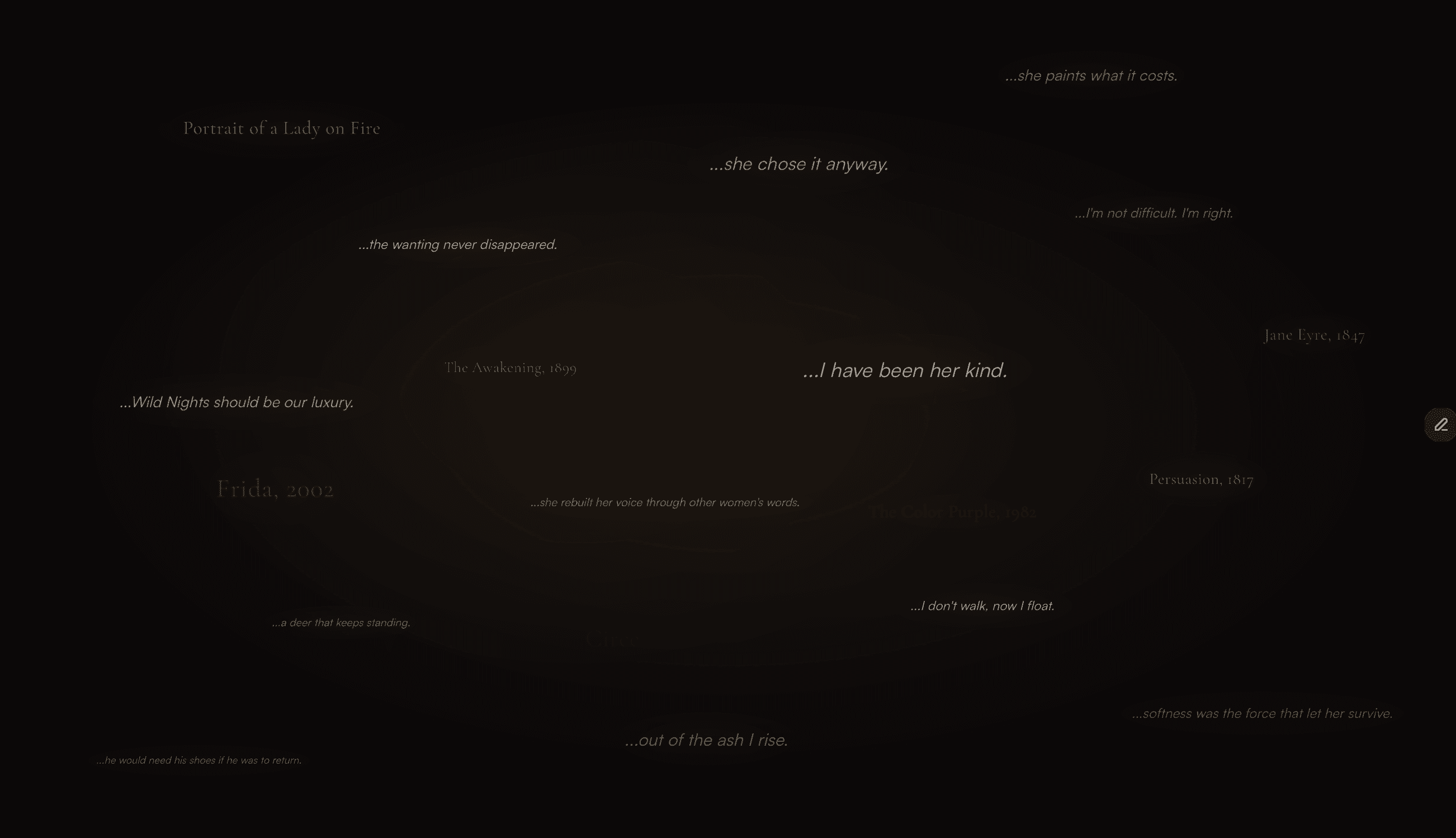
my favorite moment in the sulking room. the "whisper wall" where women's word across time speak to you, pulled from a 95-canon I hand selected. the drama of this whole experience fills my soul. i wanted it to feel cinematic and special for every woman who entered.
Closing Signal