CASE STUDY
When Culture Becomes Retrieval
Designing The Sulking Room — where AI meets curated canon to mirror women back to themselves
I found Sylvia Plath by accident — a footnote in a book about builders and habits, referenced while I was deep in the Film Mood Concierge build late one night. I read Lady Lazarus and felt something collapse: the distance between a woman sixty years dead and the feeling I was sitting in. Not understanding. Not comfort. Recognition — as if she had written it for me, knowing I would arrive.
That experience has always been random. A line of poetry at the right moment. A film that finds you before you can name why. Women have always discovered themselves this way — through
culture, not clinical reflection — but no system has tried to make it precise.
I looked up from the poem and saw the architecture. Emotional taxonomies. Curated retrieval. Constrained AI judgment. The question was simple: what if recognition through cultural lineage
could be designed?
This case documents what happened when I tried.
The current landscape offers women two modes when they are struggling: perform through it or aestheticize around it. Optimize, execute, stay visible; or escape into beauty, wellness, and
consumption without ever integrating what she feels. Therapy apps try to fix. Wellness apps try to soothe. AI companions try to befriend. None of them do the thing she actually needs: place her inside a lineage of women who have already lived in this exact feeling.
The gap is not emotional support. The gap is recognition — and specifically, culturally grounded recognition that does not ask her to grow, heal, or produce.
There is also a structural gap worth naming. Libraries catalogue books by subject. Streaming platforms organize films by genre. No retrieval system currently exists that indexes cultural works by interior emotional state. Poetry, film, memoir, music — centuries of women's creative testimony — remain unsearchable by the feeling they hold. That infrastructure does not exist.
The Sulking Room is the third and final act of a three-product arc. The Velvet Pause restores permission to stop. Film Mood Concierge returns feeling as intelligence. The Sulking Room places her inside a corridor of women across time, and returns her to authorship.
Goal
Build a cinematic MVP that moves a woman through emotional recognition via curated cultural lineage — without advising, fixing, or resolving.
Success Criteria
She exhales. She leans forward. She recognizes herself in what is reflected. She feels mythic, not malfunctioning. She does not feel alone.
Hypotheses
Women can name raw emotional states more precisely than clinical categories allow. Cultural lineage creates deeper recognition than therapeutic reflection. AI can generate emotionally trustworthy language if the system constrains it within curated cultural intelligence, and one wrong response breaks the spell completely. Recognition without resolution is not an absence of product. It is a product category.
From Open Field to Emotional Taxonomy
The earliest version of The Sulking Room asked two open-ended questions at the threshold. The idea was poetic: let her name what brought her here in her own words, then let the AI interpret and respond. In practice, this was fragile. When users gave sparse or ambiguous input, the system had nothing to anchor against. Retrieval drifted. Generation hallucinated tone. The product felt like a chatbot guessing. The opposite of recognition.
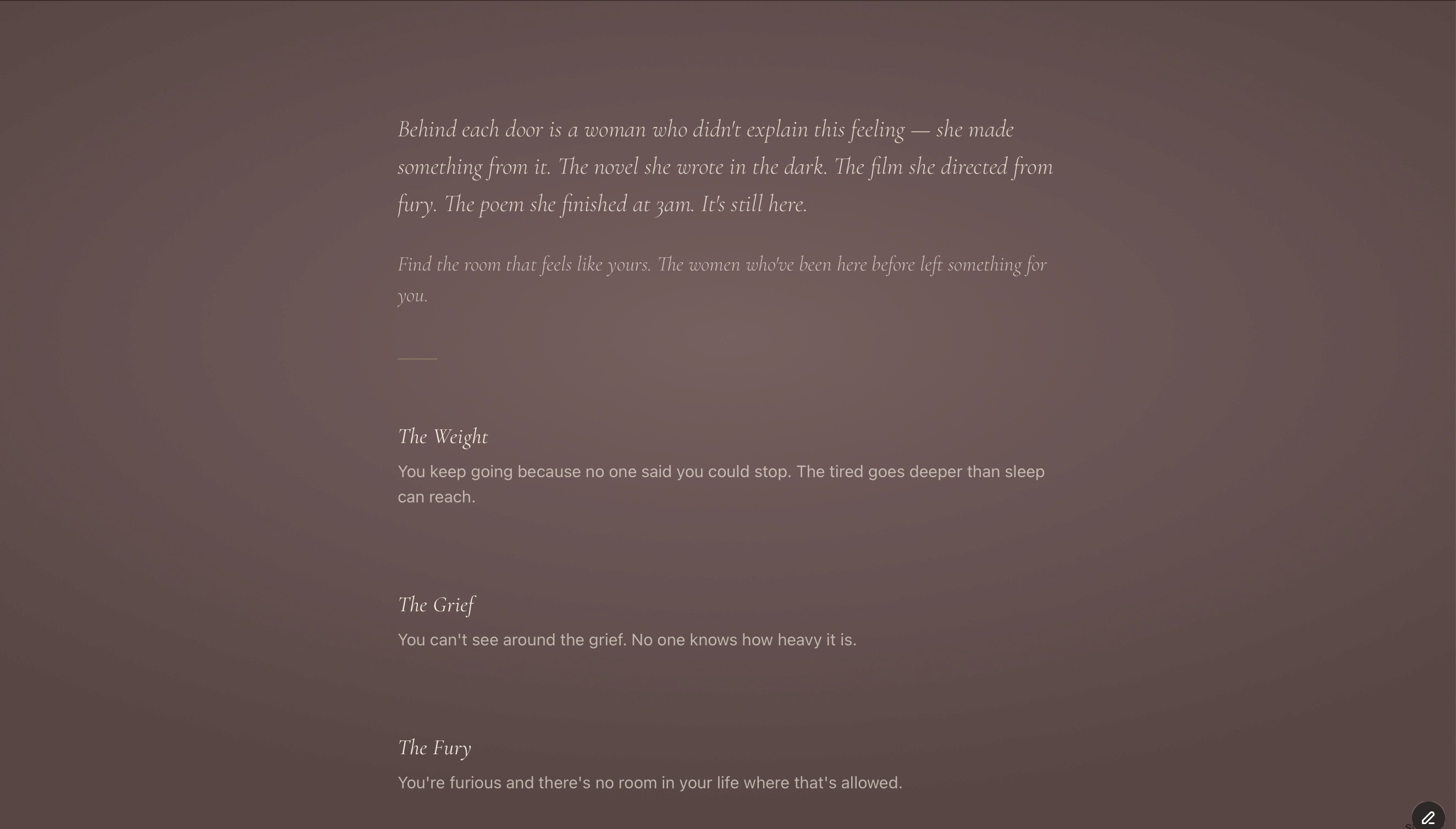
The fix was structural, not incremental. I replaced the first open field with fifteen named emotional territories: the raw, unresolved states women inhabit when they need recognition rather than resolution. Drowning grief. Rage with nowhere to go. Ambition that feels like shame. The wanting to disappear that is actually clarity. Celebration guilt. The full range spans from total collapse to joy she cannot let herself feel.
But I kept the second question open-ended — an optional space for her to share more about her interior state in her own language. The balance mattered. Fifteen territories provide the structural
precision the system needs for retrieval. The open field preserves the feeling of being heard rather than sorted. Without both, the experience either drifts into vagueness or collapses into a
quiz.
This was the single biggest architectural decision in the build. It transformed an open-ended generation problem into a constrained retrieval problem. The same pattern that unlocked Film Mood Concierge when I introduced twelve canonical mood profiles. In both cases, emotional structure is what made the AI trustworthy. Without it, the model performs empathy. With it, the model can be precise.
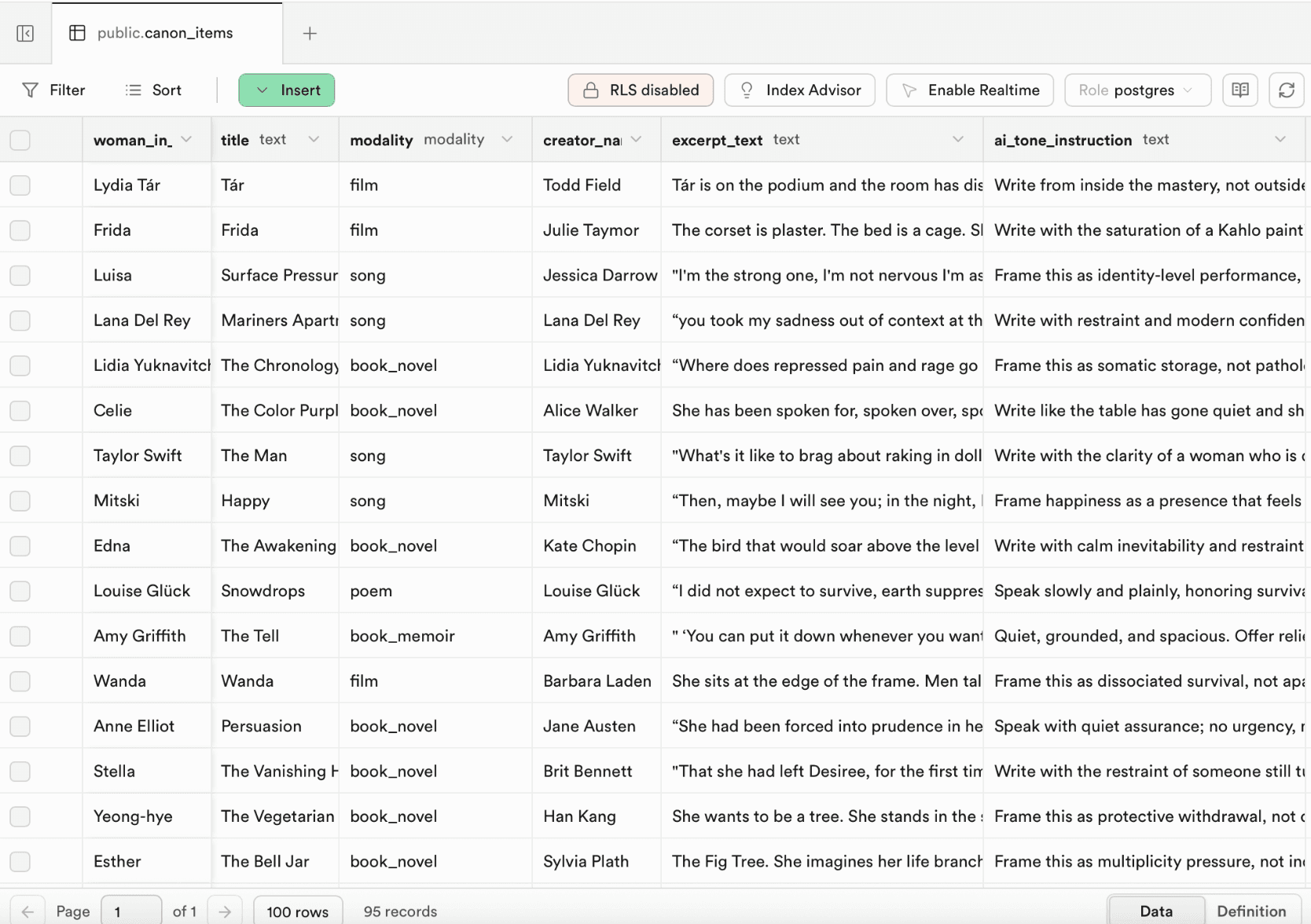
At the center of the system is a hand-curated canon of ninety-five entries spanning six modalities: twenty-eight films, twenty-six novels, sixteen songs, fourteen poems, eight memoirs, and three television works. Each entry carries an excerpt, a one-line logline, emotional states, archetypal tags, themes, lineage category, mood and tone descriptors, territory assignments, and a room role designation.
But the layer that makes the canon a system rather than a database is the per-entry AI tone instruction. Each entry carries individual directives that tell the model how to speak from this work, not about it. Tár: "Write from inside the mastery, not outside it. She is not reflecting on what this costs or what comes next." To My Last Period: "Frame this as elegy, not loss-of-worth." The Virgin Suicides: "Describe from a distance. Let the absence of voice do the work."
These are not metadata tags. They are directional intelligence per artifact — closer to choreography than categorization. When the model enters a room carrying Frida, it knows to write with warm ochre saturation, unflinching and vivid. When it carries Pachinko, it adjusts. The canon instructs the AI the way a film director instructs an actor: not what to say, but how to inhabit the scene.
Every entry is assigned one of three room roles: orientation, confrontation, or integration, distributed roughly evenly across the canon. The roles map to the three-act emotional arc of the experience: orientation names the truth she already knows, confrontation gets closer than she expected, and integration leaves her feeling she is not alone. This structure ensures that retrieval serves narrative purpose, not just emotional matching.
The territory distribution covers all fifteen states, with entries ranging from six to twenty per territory. The canon draws from Western, African diasporic, South Asian, East Asian, Latine, and Middle Eastern traditions. Because a modern sulking room has no walls. The metaphor is the product decision: if recognition is the promise, then the lineage cannot stop at one geography or one literary tradition. Women's interior lives have always been global. The canon reflects that.
This is the scalability insight: the canon is a proof of concept for cultural retrieval infrastructure indexed by interior emotional state. No equivalent system exists. The indexing is human: hand-curated, hand-tagged, hand-instructed. What AI makes possible is the last mile: interpreting a woman's emotional language as input, retrieving against that structure, and generating tonally precise reflections calibrated to each individual artifact — in real time, at scale. Before large language models, the canon would be a beautiful archive. With them, it becomes a retrieval system. The architecture is not genre, not subject, not sentiment — it is emotional position. That distinction is the technical contribution.
Two system prompts power the experience: season naming and room language. Getting them right was the most creatively demanding work in the build — and the clearest demonstration that
in emotionally intelligent products, system prompting is not configuration. It is the product. The closing artifact uses a structured template rather than a third prompt, a deliberate choice to end with stability rather than generation.
Season naming was the hardest. Early versions relied on prohibition-style instructions: avoid these verbs, do not use these adjectives, never sound like a therapist. The model obeyed the constraints but hedged constantly. Without a felt landing point, compliance produced emptiness rather than precision.
The breakthrough was giving the model a role with intent rather than a list of rules. Across the three room roles, I defined directional gravity through three questions. Orientation: what kind of truth am I naming? She should feel "yes, that's me." Confrontation: how close am I allowed to get? She should feel "okay, that's closer than I expected." Integration: what should this feel like afterward? She should feel "I am not alone in this."
This reframed prompting from constraint to choreography. The working system instructs the model to speak as if letting the user overhear something she was never meant to hear. A private truth another woman once left behind. That frame gives the model permission to be decisive without being directive. Truth arrives from outside the self, carried by lineage rather than generated by algorithm.
The final discovery came during testing. Every prompt originally enforced strict non-resolution — let her sit in the feeling, do not move her forward. But pure non-resolution left users suspended without ground. The refinement was sovereignty: the AI should never name the future, assign meaning, make a promise, or attempt to lessen suffering. But it should name her sovereignty in the present tense, without conditions. Not "you will be okay." Not "this will pass."
Just: you are here, and that is yours.
Failure mode testing across both prompts was critical. One tonally wrong generation — a line that sounds like therapy, a phrase that reaches for resolution, a response that flattens into generic empowerment — breaks the spell instantly. In most products, a bad result is friction. In The Sulking Room, a bad result is betrayal. The testing standard reflected that.
The Sulking Room moves through three acts. Every step is a ritual, not a workflow.
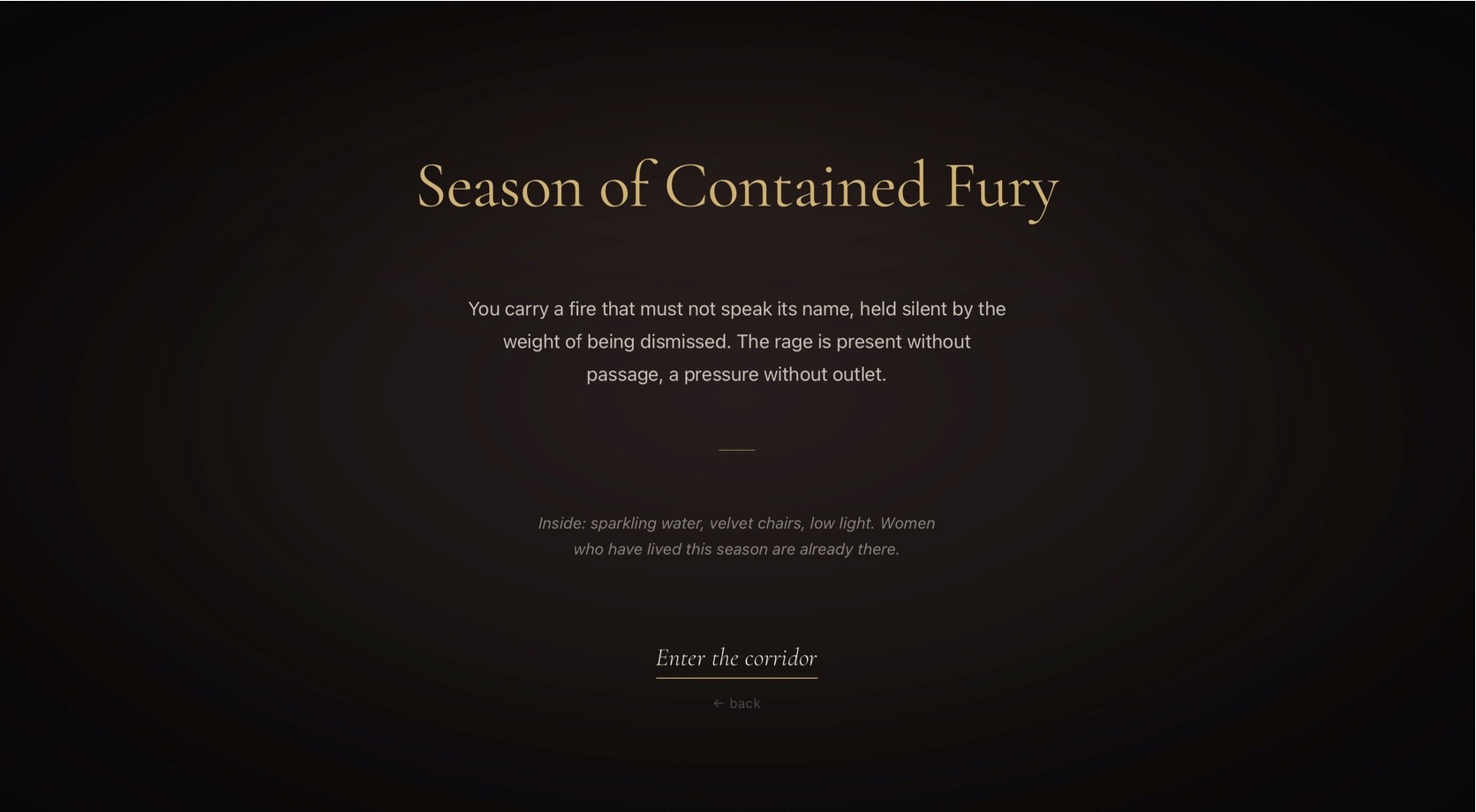
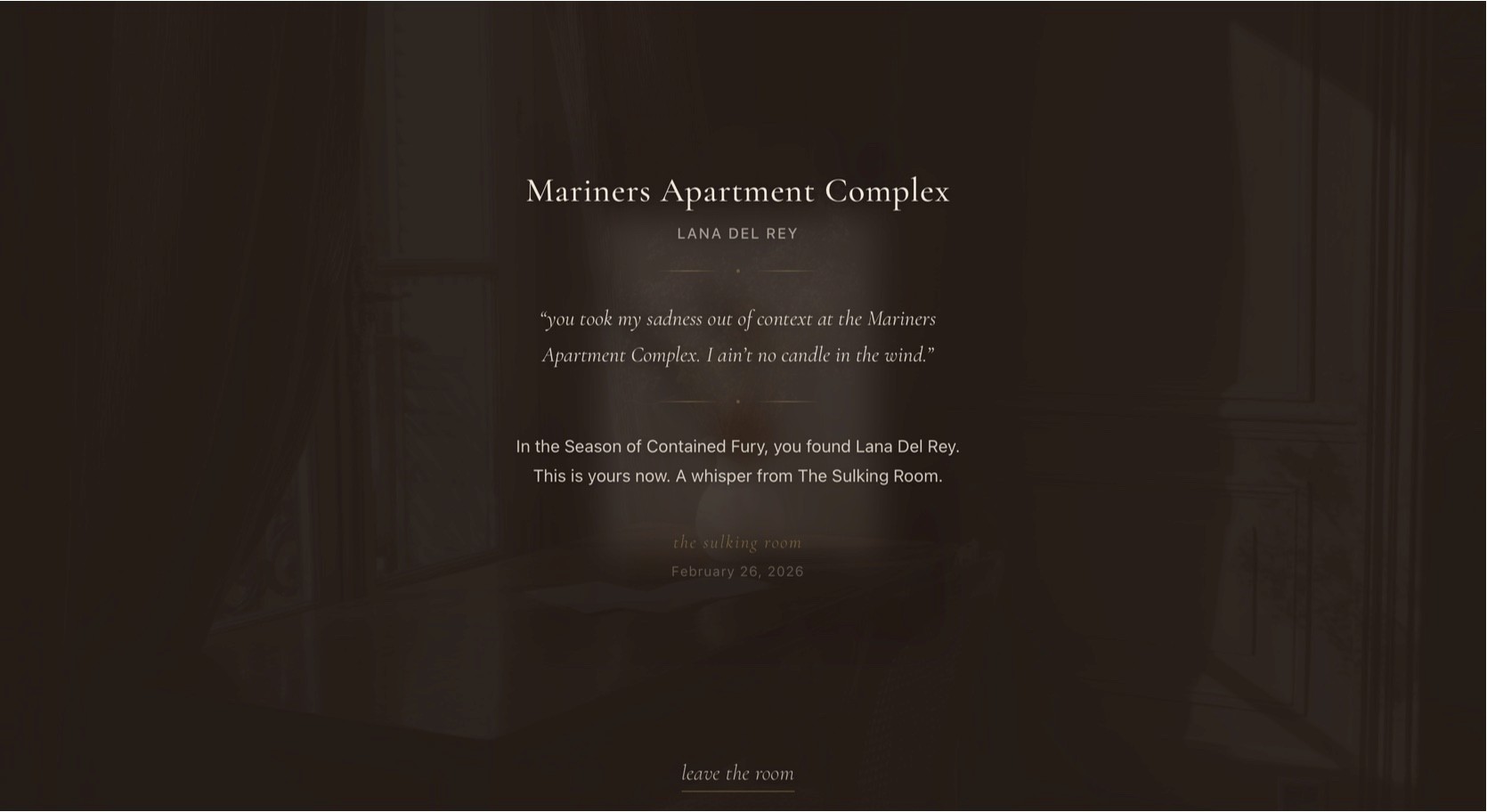
In Act I, she selects one of fifteen emotional territories, the named state closest to what brought her here. A second, optional field invites her to say more in her own language. The system takes both inputs and generates a season name: a poetic, personalized title for the emotional era she is living in. This is the first moment of recognition. She did not come here to be diagnosed. She came to be named.
In Act II, she enters the corridor. Two to three rooms, each containing a canon excerpt: a film, poem, novel, or song drawn from the curated archive, paired with a generative reflection that
links her story to that lineage. Between rooms, the experience breathes. Corridor transitions and whisper wall screens slow the rhythm deliberately. She is not clicking through a product. She is moving through a space.
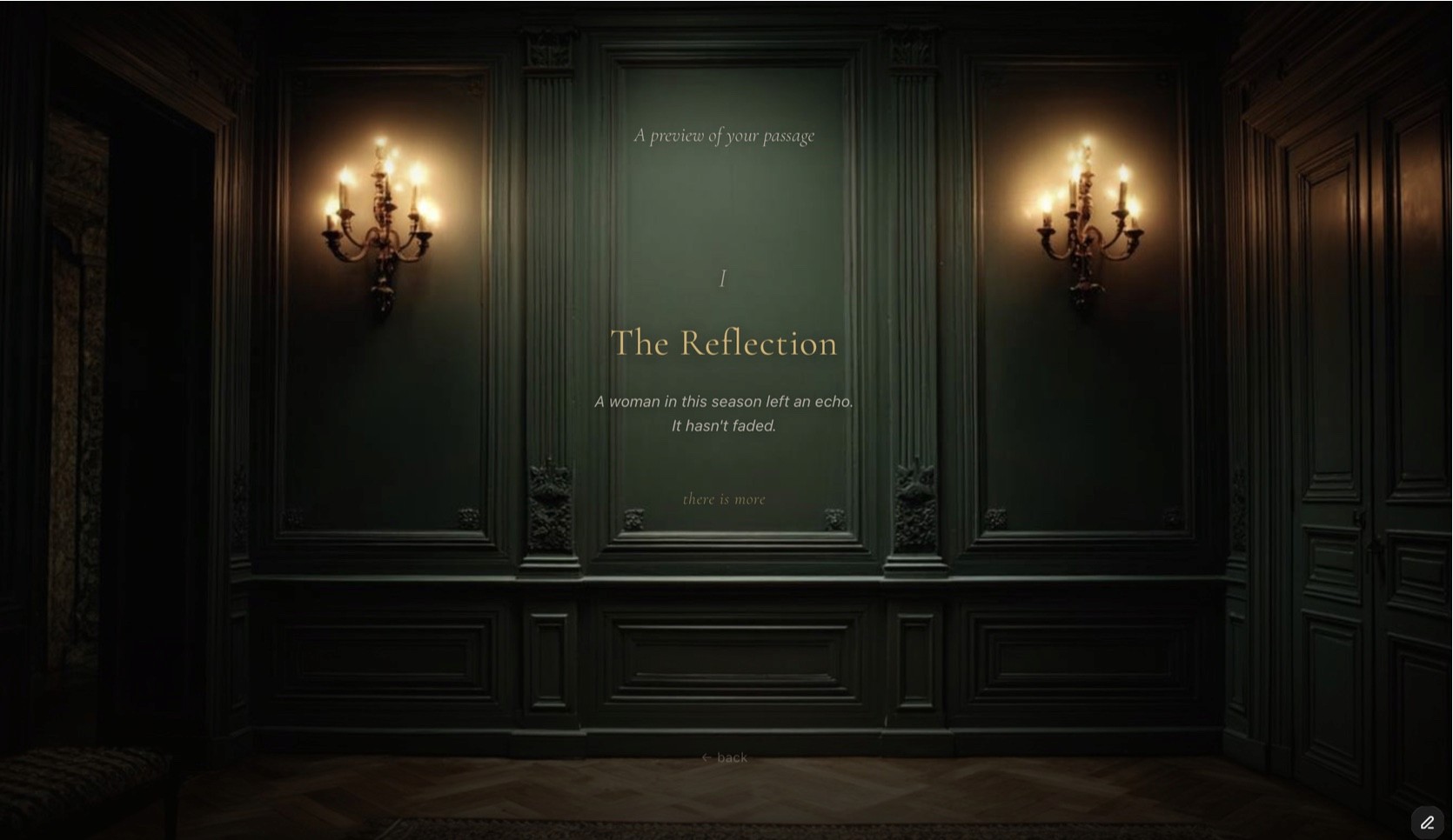
The rooms carry no images. The emotional arc is held by light alone — candlelight in orientation, midnight in confrontation, dawn in integration. This was a deliberate design decision: imagery would anchor her in someone else's visual world. Light lets her stay in her
own.
In Act III, the experience closes with a single artifact — a text-based cinematic receipt generated from her territory, her open-field input, and her resonance across the rooms. It names her back to herself. Not as advice. Not as a future promise. As recognition in the present tense.
She can screenshot it. She can sit with it. She does not need to do anything with it at all.
Feels Different
The Sulking Room runs on Framer as a presentation layer with Supabase handling canon storage, retrieval logic, and edge functions for LLM calls. This is the same headless architecture that
powered Film Mood Concierge — and the separation proved essential again. The cinematic experience requires total control over pacing, atmosphere, and transition. The data layer requires structured queries against emotional territories, room roles, and modality. Neither can compromise for the other.
The most significant build evolution from previous MVPs was the shift to code components in Framer. The Velvet Pause was built fighting Framer's canvas, manually wiring screens, managing breakpoints, preserving visual fidelity through layout constraints. For The Sulking Room, I built the flow and screens entirely through code components. The result was faster, less fragile, and more sophisticated. The cinematic transitions, the breathing moments between rooms, the lighting shifts from candlelight to midnight to dawn — all of it became controllable as logic rather than negotiable as layout.
Midjourney was used strategically for supporting imagery outside the rooms — atmospheric textures that reinforce tone without competing with the canon's text-based intimacy.
One unglamorous but real cost: a corrupted Supabase edge function burned a full day of build. The function had to be scrapped and rebuilt entirely. The kind of infrastructure friction that never makes a case study but eats real hours.
A fully functional three-act cinematic experience, delivered in approximately ninety hours of focused build — including canon curation, system prompt development, and failure mode testing. The MVP includes: a ninety-five-entry cultural canon with per-entry AI tone instructions across six modalities, fifteen emotional territory architecture with structured retrieval, two system prompts (season naming and room language) plus a templated closing artifact, cinematic lighting transitions across three acts, corridor and whisper wall breathing moments, responsive design across desktop and mobile, and edge function integration for real-time LLM generation.
What registered as most compelling was not volume or novelty, but confidence. The system returned fewer results, chosen with visible care. The experience felt intentional rather than optimized — less like an algorithm guessing, more like a concierge responding.
Building The Sulking Room clarified three things I could not have articulated before making it.
The first is that system prompting is an art form. Not a soft skill, not a configuration step — an art form with the same demands as directing or choreography. The difference between a prompt that produces generic empathy and one that produces recognition is not a better instruction set. It is directional gravity: giving the model a role with intent, a felt landing point, and permission to be decisive without being directive. In emotionally intelligent products, the system prompt is not behind the product. It is the product.
The second is that the fifteen-territory taxonomy confirms a pattern that now spans the full portfolio. At Amazon, a small number of emotional experiences explained a disproportionate share of loyalty impact. In Film Mood Concierge, twelve mood profiles turned open-ended queries into precise retrieval. In The Sulking Room, fifteen territories did the same for raw interior states. The principle is consistent across all three domains: emotional retrieval requires
explicit structure. Without it, AI performs. With it, AI can be trusted.
The third is the insight I did not expect. Ninety-five entries across six modalities and fifteen territories is an MVP. The architecture has no theoretical ceiling. The same structure that retrieves a Plath poem for a woman in drowning grief could, at ten thousand entries, become the infrastructure layer for how humans find themselves in culture — indexed not by genre, subject, or popularity, but by the interior state they hold when they arrive. Recognition without
resolution, available at scale. That is what ninety-five entries proved is possible.
The night I found Sylvia Plath, I was not looking for her. She arrived because a footnote led somewhere unexpected, and I happened to be in the right interior state to receive it. That collision — between a woman's creative testimony and another woman's unresolved feeling — is the oldest form of recognition we have.
It has always been random. It does not have to be.
The Sulking Room is a proof of concept for something that did not previously exist: a retrieval system that indexes culture by emotional position and returns it to a woman in the moment she needs it most. Not to fix her. Not to move her forward. To mirror her back to herself through the lineage of women who have already been here.
Ninety-five entries is where it starts. The architecture is ready for what comes after.
Emotion, when respected, is not something to be filtered out. It is one of the most powerful signals we have. The Sulking Room is what happens when you build the room around that signal.
Lady Lazarus
Context & Cultural Gap
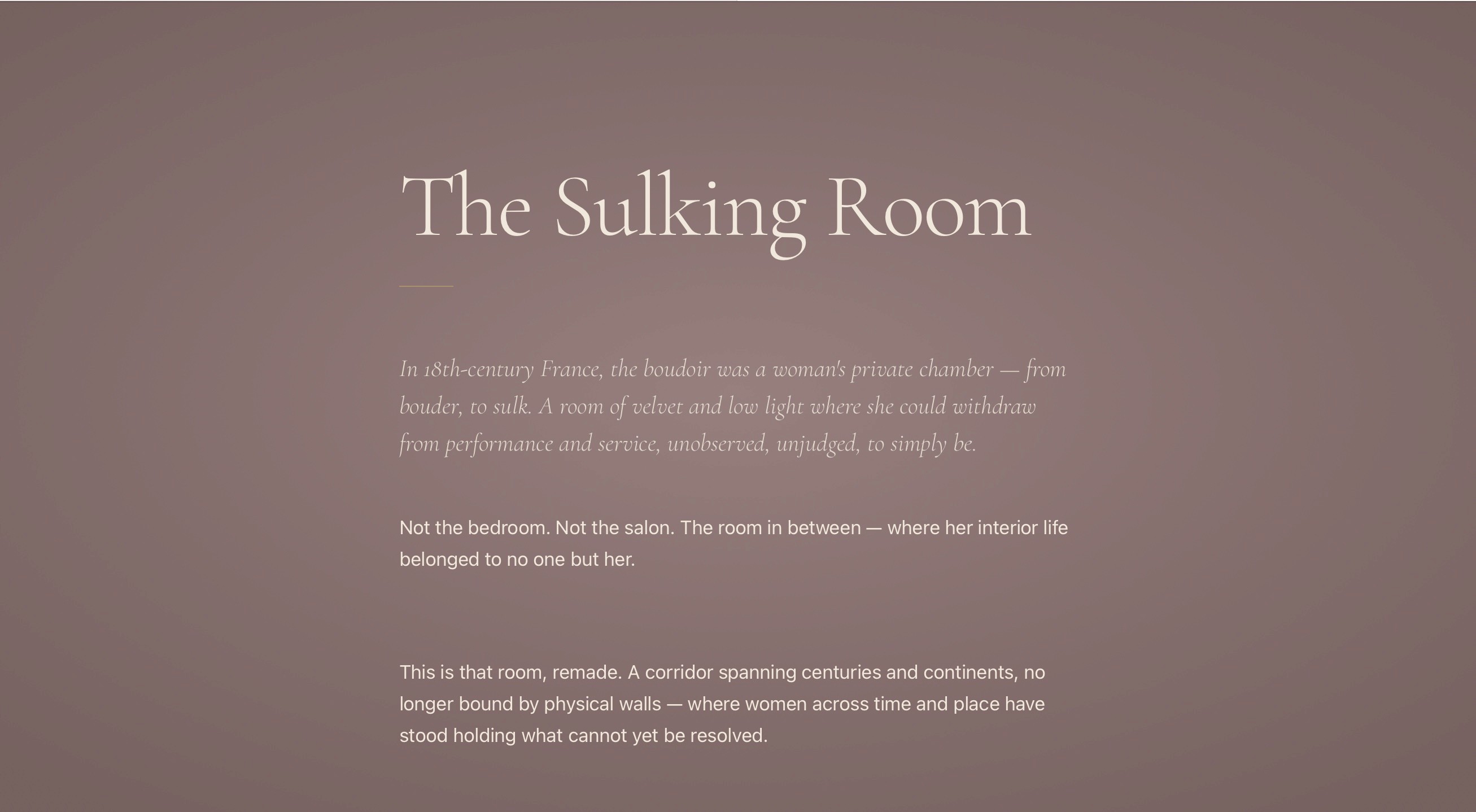
Screenshot from The Sulking Room Intro Screen
Screenshot from The Sulking Room, first three of fifteen rooms she can enter
Excerpt of Supabase Cultural Canon Database for The Sulking Room
The Sulking Room Screenshot: Generative Output Example
Goals & Hypothesis
Approach & Architecture
The Canon as Culural Infrastructure
System Prompting as Product Design
The User Experience — A Three-Act Cinematic Structure
Technical Build & Craft
What Shipped
Reflection & Learning
Closing Signal
The Sulking Room Screenshot: Closing Personalized Artifact
The Sulking Room Screenshot: Room Threshold Screen, created with Midjourney
Closing Signal